  | |||||||||
| ABOUT CONTACT CONTRIBUTION OVERVIEW TUTORIALS LEGAL/COPYRIGHT A | B | C | D | E | F | G | H | I | J | K | L | M | N | O | P | Q | R | S | T | U | V | W | X | Y | Z | Dates | |||||||||
CREATED 7/31/2013 WARNING:
This site deals only with the corporate corruption of science, and makes no inference about the motives or activities of individuals involved.
|
OPINION ONLY
David G Tuerck— A cash-for-comment economist from Beacon Hill Institute (founder also), Suffolk University in Boston who was available to help the tobacco industry through the economist's network run by Tollison and Savarese. —
He joined the Tobacco Institute's cash-for-comments economists network in 1989. This had been set up by Professor Bob Tollison at the Center for the Study of Public Choice (George Mason University) with the help of Profs. Henry Butler and James Buchanan (who was Tuerck's PhD supervisor.)
The mechanics of the network — and the cut-out for keeping payments confidential — were run by James Savarese & Associates, a long-term consultant to the Tobacco Institute who specialised in recruiting academic economists.
The scope and activities of this network can be seen in a Febuary 6 1987 letter to the network participants. We are finally ready to get this first op-ed project off the ground. I am asking you to review the attached materials and write an editorial for a major newspaper in your state. This article should support the basic right to advertise legal products and oppose attempts to restrict advertising either by outright bans or by punitive use of the tax code.   He now is professor and chairman of the Suffolk University Department of Economics and president of the Beacon Hill Institute at Suffolk University. He makes many television and radio appearances and has testified before the U.S. Senate Committee on Labor and Human Resources, Subcommittee on Children and Families, as well as various committees of the Massachusetts legislature. He is past president of the North American Economics and Finance Association. He has been a Heritage Foundation Policy Expert in Economics and once served as the director of the Center for Research and Advertising at the American Enterprise Institute (AEI). His stance on Climate Change "Scientific questions are above my pay grade ... I'm not in the business of asking whether the earth is warming ..."[Source: Speech at the Third International Conference on Climate Change.]  Tuerck's Affiliations
| ||||||||

 David G. Tuerck serves as professor and chairman of the Suffolk University Department of Economics.
| Could there be two David G Tuercks? |
|---|
|
1973 Aug 11: There is a David G Tuerck working with Thomas P Comer in California, writing letters to The Lancet on venous thrombo-embolisms. 1975 Apr: A study on the Risk Factors in Stroke, "Comparison of strokes in women of childbearing age in Rochester, Minnesota and Bakersfield" in California Angiology carries the names Comer TP, Tuerck DG, Bilas RA, Clow SF, Falero F Jr, Raskind RR This PubMed index also shows two other similar papers in 1973' 
There are no biomedical papers by David G Tuerck after 1975, and no economic/advertising papers before 1975. |
• Professor and chairman of the Suffolk University, Department of Economics, Boston, MA He also runs the Beacon Hill Institute (BHI), which is a extreme free-market promoting think-tank funded by the Coors family (Castle Rock Foundation) and the Lynde and Harry Bradley Foundation.
The Beacon Hill Institute is said to be "attached to the Economics Department of Suffolk University in Boston."
• Education:
— AM, Economic Policy A.B., International Affairs, The George Washington University. [Source: Suffolk University].
— Doctorate in economics from the University of Virginia. [Source: Beacon Hill Institute].
1976: "The Economic Consequences of Devaluation of Reserve Currency Country," World Monetary Disorder, Patrick Boarman and David Tuerck, editors, Praeger Publishers, New York, 1976.
1976 Feb 17: Walker Merryman at the Tobacco Institute suggests they have research done by the Center for Research on Advertising (Director is David Tuerck) at the American Enterprise Institute (AEI).
If we are interested in having some research done into public service advertising by the major health organizations and agencies of government concerning smoking and health, the American Enterprise Institute may be interested.
[There is only one reason why they would want this data — to attack the government 'waste' in running anti-smoking programs.]
I understand, through a third party, that David Tuerck, Director of the Center for Research on Advertising at the Institute, has evidenced some interest in counter advertising and a defense of commercial advertising practices.
Since the distortions and inaccuracies in much of the smoking-health psa material are so obvious, it might be worth our while to contact Mr Tuerck and ask him about such a project.
[The AEI is now one of the leading groups contributing to the PR war against human-induced global warming. It has received at least $2,825,000 from ExxonMobil since 1998, and not much less from the tobacco industry.]
1976 July 6: Conference held at the American Enterprises Institute. David Tuerck was the editor of the proceedings published under the name the Political Economy of Advertising, [NOTE: MANY THOUSANDS OF PAGES]
1977 Apr 19: David Tuerck at the AEI writes to RJ Reynold's top scientific disinformation executive, Frank Colby. He has been approached by Ed Jacob, the tobacco industry's law firm which looked after secret payment via Special Account #4. Tuerck spells out the position the AEI researcher would take in conducting this research.
My broad purpose is to determine whether such regulation is likely, on balance, to lead the consumer closer to or further from the "truth" (somehow defined) about product characteristics.
The conventional approach to this issue assumes that governmental regulation can be expected to reduce the amount of deception to which the consumer is exposed and, in the process, to move him closer to the truth. My approach would be to assume that government — and the scientific research on which it relies — is as capable of deception as the firms whose advertising and labeling it regulates.
My question to you is whether the data bearing on tobacco and health are adequate in this sense. [That cigarettes increase the risk of disease.]
Are the laws that regulate cigarette advertising and labeling based on a realistic assessment of the prior risk of cancer or not? Has this prior risk been taken into consideration at all, or does the preponderance of medical opinion — and the public policy based on it — reflect a "naive" interpretation of the evidence?
Your help with these questions will assist me in my efforts to explore and test a general theory of regulating information flows. I am interested not only in the tobacco problem but also in the whole process with which certain agencies, particularly the FTC and the FDA, are getting into the business nowadays of dictating labels and advertising copy for a wide range of products, including foods and OTC drugs.
The same letter was sent to Ed Jacobs at Jacob Medinger & Finnegan
1977 Sep 11: William Baroody, Jr, Exec VP of the American Enterprise Institute writes on first-name terms to Fred Panzer at the Tobacco Institute sending some brochures in appreciation of "your interest in the Asssociate's program."
1978: David G. Tuerck and the American Enterprise Institute publish "Advertising and the Public Economy: Some Preliminary Ruminations,"
in The Political Economy of Advertising. Tuerck has edited it. Richard Wager is one of the contributors.
1980 Oct: The Tobacco Merchants newsletter reports on his edited AEI publication "Issues in Advertising: the economics of persuasion" which is the proceedings of a symposia.
1981: Prior to joining Suffolk University in 1982, he was a director in the Economic Analysis Group at Coopers & Lybrand, Washington, DC
1982 Jan 12: Raboy is reporting to Ed Feulner, on the IRET Activities in 1981. Feulner is President both of the Heritage Foundation and IRET - and they run joint conferences.
Raboy with Michael Schuyler and Mai Nguyen Woo has:
- published seven Economic Reports
- published three major articles
- testified before Congress four times
- run four Supply side seminars, with George Gilder, Norman Ture, Al Ulman, and Michael Boskin (Stanford Uni and Hoover institute)
- Speaking Engagements
Also agenda for a conference of Heritage and IRET with David Tuerck (Cooper & Lybrand), Irving Kristol, Paul Craig Roberts, Norman Ture, Jack Albertine, Dennis Ippolino, David Meiselman.
[The Agenda doesn't say what the conference is about]
1982 Feb 18: Conference by the Heritage Foundation and the Institute for Research on the Economics of Taxation (IRET). It has him listed as "Cooper & Lybrand" as a speaker.
1982 June: /E Associate Professor of Economics at Suffolk University
1986 Dec: /E The Interpublic Group of Companies (which was rapidly buying up advertising agencies and PR companies around the world) had David Tuerck provide material for its Annual Report. A later document says:
IAA's Richard Corner has observed that advertising is, in fact, crucial to the economic survival of media, keeping its price to consumers reasonable and affordable. "[Corner was actually Director, Corporate Affairs for Philip Morris in Europe who was working with the Institute for Advertising Agencies to retain tobacco advertising.][With a triple back-flip and double somersault he has managed to completely invert the arguments that advertising acts antagonistically — against the pressure for better quality and lower priced products. The man is either a genuius or a moron.]
Mass media unsupported by advertising would be extremely limited in number and would be unable to provide the wide range of differentiated editorial material and programming that is available only in those countries with a broad array of advertiser-supported media.
The media that was available to consumers would be largely controlled by the government, and would inevitably be influenced by the media to support the policies and programs of those in power.
[Like the PBS, the BBC, Australian Broadcasting Comm. etc]
Those with policies or ideas contrary to the ruling government regime would be tightly restricted in their ability to communicate effectively about a wide range of political and social issues. "Advertising, on the other hand," says Mr Corner, "allows media to be independent. "
David Tuerck, of the Beacon Hill Institute for Public Policy Research, and Professor and Chairman, Department of Economics, Suffolk University, Boston, Massachusetts, presented a vivid picture of what the world might be like if advertising's critics prevailed and it was legislated out of existence (Tuerck, D., Interpublic Group of Companies' 1987 Annual Report).
In a world without advertising, he wrote, in part," consumers would lack a means of distinguishing one product from another. Producers [of products and services] lack a means by which to reward themselves for successfully establishing a particular product as a benchmark for quality.
"By eliminating an important means by which to compete, the disappearance of advertising would discourage competition. [snip] Just as it would discourage producers from competing over quality, the disappearance of advertising would discourage them from competing over price.
1987: Professor of Economics at Suffolk University
1987 Feb 3: Sam Chilcote of TI reports to his Executive Committee providing 29 pages of revealing outlines of their activities, consultants, etc.
New Activities:
Excise Tax Issues: (Resources)
The following individuals, organizations and materials are being utilized to oppose increases in cigarette excise taxes:
Economists have been identified in key House and Senate Congressional districts to prepare op-ed pieces opposing increases in the federal excise tax. The economists are positioning excise tax increases as a band-aid approach to state and federal fiscal responsibility. We have utilized economists to testify at federal and state hearings and to participate in tax seminars.
1988 Jan 15: Jim Savarese and Associates, joint subcontracts with Ogilvy & Mather, is outlining the arragements for handling the economists and the labor unions to the Tobacco Institute
Nineteen eighty-seven was a banner year for the Tobacco Institute in its fight against excise tax increases at the federal level.He then outlines a couple of problem areas before dealing with the "Economists Program." [No full list for these 42 network economists appears to exist]
Through careful coalition building and effective message dissemination, the Institute was able to fight the battle on its own terms and secure a substantial victory.
In reviewing your 1988 plans, we found many areas where Ogilvy & Mather and Savarese and Associates can continue to provide services. There are also new areas where we have expertise which have not been fully explored.
Our work with the network of forty-two economists should continue into 1988. In 1987, the network was effective in producing op-eds and submitting and presenting testimony. These activities should continue in 1988. In addition, the economists network can be used for editorial board briefings, presentations at conferences and the placement of articles on this issue with major media outlets.
In order to make the most of the new opportunities for the economist network, several factors must be taken into consideration:The opportunity exists to place economists on key economic programs, panels, and at national and regional tax policy conferences. As an addendum to this effort, it is possible to have their comments reprinted and distributed.
- only 7 or 8 of the economists within the network have the potential to make presentations to editorial boards and conferences.
- those economists selected to make presentations to editorial boards and conferences need a training program. This program may include media training through Michael Sheehan and briefings by Jim Savarese and Bob Tollison.
- the editorial board program is a limited strategy with applicability mainly at the federal level with some use at the state level.
- when implementing the editorial board program, Ogilvy & Mather can assist with pitch materials, press kits, and a placement program.
They also want to commission studies. They suggest:
They also propose to work with a number of right-wing tax groups, some left-wing labor groups, minority groups, senior citizens, agricultural groups, and advertising companies. They propose to sponsor conferences, and make a video on excise taxes.
- Effects of an excise tax increase on the federal budget (and its fairness)
- on bootlegging "and come up with some strong conclusions" [predetermined!]
- In addition, Savarese and Associates can locate a conservative economist to make the argument that there is an acceleration of government spending when taxes are increased. The program will include placement in an economic journal.
A national Excise Tax Op-ed Program will target various importnat members of the Congress and big businessmen (e.g. Lee Iaococca) on the National Economic Commission (NEC). The network economists will be required to target specific newspapers, and a few key political figures. The target for this member of the network is:
Boston
Targeted paper: Boston Globe
Economist: David Tuerck, Suffolk University
[Why selected:] Commission members Sen. Patrick Moynihan and Felix Rohatyn are from New York. Because we have great difficulty in getting published in New York, we have decided to target the entire Northeast area.
1988 Mar 31: Jim Savarese is writing to Jeff Ross at the Tobacco Institute re the National Economic Commission (NEC) and their Excise Tax Op-Ed Project using selected members of the cash-for-comments economists network.
I have listed below areas that we should target that would be beneficial in reaching members of the NEC. Also attached are the materials that we will send out to the authors.
Commission members Sen. Patrick Moynihan and Felix Rohatyn are from New York. Because we have great difficulty in getting published in New York, we have decided to target the entire Northeast area.
Boston:
Targeted paper: Boston Globe
Economist: David Tuerck, Suffolk University
1988 May: Savarese has sent the Tobacco Institute a bundle of clippings of the articles planted by this and other economists in their newpapers. This is proof of service, required for payment.
Tuerck has managed to plant "A Sinful Proposal" on The Boston Globe (June 13)
1988 June: /E Excise Tax Letter-Writing Fact Sheet. This is a list of points that the Tobacco Institute wanted the economists to include in their op-ed articles.
This was followed by
- Excise taxes are regressive
- Excise taxes are fundamentally inequitable
- Excise taxes are an unfair burden on minorities
- Government data demonstrates the unfairness of excise taxes.
- Excise taxes are arbitrary
- Excise taxes are hidden taxes
- Excise taxes are an unfair burden on businesses
- Excise taxes are bad economic policy
- Excise taxes are historically controversial.
- pages of data so that the economists got their facts right,
- a series of quotes that could be incorporated into the article.
- pages of State-by-State data including the number of jobs that the Tobacco Institute estimated would be lost by higher cigarette excises
- lost revenues for each State, due, it was claimed, to cross-state bootlegging and smuggling.
- a list of Congressmen to be contacted in every region.
- Tollison's C/V
1988 June 2: James Savarese has advised the Tobacco Institute on the current status of the "NEC Excise Tax" project.
[NEC = National Economic Commission, the federal planning group they were trying to influence.]
The cash-for-comments economists involved were Abrams, Armentano, Clark, Dalton, David, Davis, Howe, Logue, Maurice, Mitchell, Parkman, Sandler, Tuerck, Wyrick, and Miletello
As it now stands, 5 articles have been published, 2 articles (New Mexico and Missouri) are forthcoming, 6 articles have been submitted for publication, and 5 articles are in the revision stage. We have contacted the authors of the articles which are in the revision stage and those articles should be submitted by the end of next week.
1988 June 13: David Tuerck's article "A sinful proposition" appears in The Boston Globe. It attacks he "impending 5 percent state sales tax on cigarettes" and "the proposed National Economic Commission's (NEC) deficit reduction plan [] which is likely to recommend an increase in federal excise taxes" while promoting income tax as the way to reduce the deficit.
Of course it does not reveal that Tuerck was paid by the tobacco industry to promote their opposition to excise taxes.
1988 June 23: Debbie Schoonmaker at the Tobacco Institute receives a memo from contract organiser James Savarese with "an update status on the NEC Op-Ed Project:
As it now stands, 9 articles have been published, 4 articles (New Mexico, Missouri, Oregon, and Idaho) are forthcoming, 4 articles have been submitted for publication, and 2 articles are in the revision stage.It lists the network economists by the state in which they operate together with the academics's successes in planting articles on their principle state newspapers.
1988 July: Tuerck article in Boston Globe column:
"There is little disagreement about singling out individual products for taxation. The idea is one of the worst ways of raising revenue. This givers nonsmokers a free ride.
It encourages the idea that government can spend all it wants, provided there's a handy group of 'sinners' around to bear the cost.
It is clear, despite what the Surgeon General and others in the anti-smoking community would like others to believe, that a number of independent leaders are posing though-provoking questions. They are questions which strike at the very heart of the cherished goals of our foes. They forsee a 'smoke-free-society by the year 2000. They appear to be willing to go to any lengths in order to enhance their political agenda."
The industry liked Tuerck's article, and sent it around to the Smoker's Rights organisations the industry was promoting. See reports in Oklahoma Smoker , New York Smoker and the Wisconsin Smoker newsletter. His quotes were also included in the various manuals and handbooks used by the Tobacco Institute and some of the companies to educate their state and regional staff lobbyists.
1988 July 6: /E Jim Savarese has sent the newspaper clippings of the National Economic Commission (NEC) Excise Tax Op-ed Program along to the Tobacco Institute. Following the second term of the Reagan Administration, the budget deficit had blown out to such an extent that it was obvious that the next President would need to find new revenue streams — and cigarettes were the obvious target. NEC was charged with making recommendations for deficit reduction.
The Tobacco Institute instructed their tame network economists to write op-eds for their designated local newspapers attacking the idea of increased excise taxes. These are newspaper clippings:
- Dom Armentano, Uni of Hartford (New Haven Register) "Reagan's successor must resist temptation to raise taxes."
- Burton Abrams, Uni of Delaware (Sunday News Journal) "Equitable and efficient ways to raise taxes."
- Dwight Lee, Uni of Georgia (The Atlanta Journal) "Tax increase won't cut budget deficit."
- Allen Dalton, Uni of Idaho (Idaho Press-Tribune) "Federal tax hike destined in 1989."
- Todd Sandler, Iowa State Uni (Cedar Rapids Gazette) "The Shape of Taxes to Come"
- John Howe, Uni of Kansas (The Capital-Journal) "Less spending, not more taxes, is the only real budget solution."
- David Tuerck, Suffolk University (The Boston Globe) "A sinful proposal".
- Thomas Wyrick, Southwest Missouri State (The News-Leader) "Higher taxes can't solve budget crisis."
- JR Clark, Fairleigh Dickinson Uni (Daily Record NJ) "Excise tax: Bitter medicine for economy."
- William Mitchell, Uni of Oregon (Register-Guard) "Tax increases not solution to reducing deficit."
- Michael Davis, Southern Methodist Uni (Dallas Times Herald) "Excise taxes are far from painless remedy."
- Charles Maurice, Texas A&M Uni (Houston Post) "Economic panel lets officials dodge the deficit bullet."
- John David, West Virginia Tech (Charleston Gazette) "Taxes will target the poor."
1988 Aug 11: Walter Woodson of the Tobacco Institute is circulating a number of the economists NEC Excise Tax op-ed clipping among his Regional Vice Presidents and Directors. One is: "A sinful proposal" by David Guerck.
1989 Jan 11: The Tobacco Institute's Scientific Consultancy Activity 1988-89
This is an 80 page mixed bag of files dumped together [Well worth perusing]. The first document is from 1990 [ordered in reverse]
- Pages 3 to 23 begin with Witness Appearances in 1988 and 1989 involving both "Indoor Air Quality experts" who work for the Tobacco Institute, and three economists [Bob Tollison, Richard Wagner and Dwight Lee]
- Pages 24 to 31 Labor IAQ Presentations in 1988 and 1989 which involves key figures in the labor movement and a few "IAQ experts."
- Pages 32 to 39 IAQ/ETS conferences attended by tobacco industry disinformation experts in 1988 and 1989
- Pages 40 to 41 Academic and Unaffiliated Scientfic Witnesses
- Pages 43 to 53 Smokers Rights Legislation in various states.
- See page 54: Tobacco Institute "Confidential" memo on "Tax Hearing Readiness" which is their battle plan to counter earmaking of cigarette excise taxes to fund health programs. It lists a large number of organizations and a few congressmen who can be relied on to help. It also has both primary and secondary lists of economists from Tollison's "cash-for-comments" network willing to give testimony.
Economists: [Primary]
The Tobacco Institute's list of cash-for-comments professors and senior academics who were available to write op-eds and give evidence at Congressional hearings, etc. had grown extensively.- Bill Orzechowski, Tobacco Institute
- Robert Tollison, George Mason University
- Richard Wagner, George Mason University
- Dwight Lee, University of Georgia, Athens
- Michael Davis, Southern Methodist University
- Gary Anderson, California State at Northridge
- William Prendergast (resource: Prendergast/Solmon papers)
- Other Network economists [see Secondary attached list below]
MASSACHUSETTS
Prof Simon Rottenberg, University of Massachusetts
Prof David Tuerck, Suffolk University
[TI budget papers show that each op-ed now earned the economists $3,000. Presentations to conferences earned them $5,000.
Savarese was paid $70 to $100,000 pa for this project; Ogilvy & Mather $2,000.]
See page 5
1989 Jan 11: The Tobacco Institute's list of cash-for-comments professors and senior academics who were available to write op-eds and give evidence at Congressional hearings, etc. This had grown extensively.
Massachusetts now has two:
- Prof Simon Rottenberg, Department of Economics, University of Massachusetts, Amherst, MA 01002
- Professor David Tuerck, Suffolk University, 8 Ashburton Place, Boston, MA 02108
1989 April 18: Susan Stuntz (Issues Manager) at the Tobacco Institute memoes her boss Sam Chilcote. She is sending him material previously used for a two-day "Gerry Long" presentation. He wants to use it in a shorter one-day (unspecified) briefing session.
[Gerald H Long was the CEO of RJ Reynolds who in 1988 had just taken over as Chairman of the Tobacco Institute's Executive Committee and wanted to make changes.]
The outline for the Powerpoint slides is here in full, together with the names of the politicians they were required to influence. It boasts that the..
Economists' Network 64 Strong [is] Targeted to Congressional Tax Writing Committees [and utilizing the] Production of Op-Eds on Federal Tax Policy.
[List of economists]
1990 May: This is a list of the newspapers designated to certain economists on the network. They are to attempt to plant an op-ed article on "Excise Taxes" on this local newspapers.
MASSACHUSETTS
David Tuerck, Suffolk University
[has been given the] Boston Globe. [as his target publication.]
1990 May 7: The Tobacco Institute's "1991 Tax and Social Cost Plans" have sections on
- "Social Costs" Hearings Readiness (preparation for fielding witnesses at Congressional hearings.) They list here the arguments that the Institute and its allies must be prepared to present.
- "Tax" Hearing Readiness (as above, but for excise tax increases, State and Federal)
- List of cash-for-comment network economists in each State.
MASSACHUSETTS
Prof Simon Rottenberg
Department of Economics, University of Massachusetts
Amherst, MA 01002 413-545-0421
Professor David Tuerck
Suffolk University
8 Ashburton Place Boston, MA 02108 617-723-4700
1990 June: /E Excise Tax Letter-Writing Fact Sheet. This is a list of points that the Tobacco Institute wanted the economists to include in their op-ed articles.
This was followed by
- Excise taxes are regressive
- Excise taxes are fundamentally inequitable
- Excise taxes are an unfair burden on minorities
- Government data demonstrates the unfairness of excise taxes.
- Excise taxes are arbitrary
- Excise taxes are hidden taxes
- Excise taxes are an unfair burden on businesses
- Excise taxes are bad economic policy
- Excise taxes are historically controversial.
- pages of data so that the economists got their facts right,
- a series of quotes that could be incorporated into the article.
- pages of State-by-State data including the number of jobs that the Tobacco Institute estimated would be lost by higher cigarette excises
- lost revenues for each State, due, it was claimed, to cross-state bootlegging and smuggling.
- a list of Congressmen to be contacted in every region.
- Tollison's C/V
1991 Jan: /E Tobacco Institute draft plan for 1991 with emphasis on "Taxes." These are the economist-related paragraphs:
Objective
To discourage reliance on consumer excise taxes on cigarettes to meet social and economic objectives by demonstrating that excise taxes are regressive and inconsistent with fair taxation.
Goals and Tactics:
- Commission two op-ed articles in 1991 from consulting economists. As articles are published, provide to other Institute decisions for promotion and submission to appropriate policy makers.
- Conduct at least 10 presentations by consulting economists on the excise tax issue before national, regional and state tax policy conferences.
- Continue to utilize consulting economists for testimony and briefings. Expand appearances to include presentations to business clubs and the business press. Conduct media refresher courses for public speaking appearance and delivery of testimony.
- Utilize the consulting economists for an op-ed program that addresses the national earmarking issue and state specific earmarking issues. As articles are published, provide to other Institute divisions and promote to appropriate public policymakers. Use field staff network to support distribution efforts.
1991 Jan 8: Savarese has sent the current list of network economists to Carol Hyrcaj at the Tobacco Institute. It contains three new names, but otherwise is essentially the same as the old lists.
David Tuerck is still listed for the State of Massachusetts at Suffolk University.
| The Beacon Hill Institute |
|---|
David Tuerck is the founder and Executive Director of the BHI at Suffolk University. According to another source it was founded in 1991 by businessman and Republican politician Ray Shamie. "BHI offers economic and policy consulting to policymakers, research institutes, business and individuals interested in policy at the local, state and federal level.The institute describes itself as "grounded in the principles of limited government, fiscal responsibility and free markets" and has accepted funding from conservative foundations such as the Castle Rock Foundation (funded by the Coors family) and the Lynde and Harry Bradley Foundation  Wikipedia Wikipedia |
| The primary funders of the Institute were Ray Shamie, the Castle Rock Foundation (funded by the Coors family); Lynde and Harry Bradley Foundation (ultra-conservative) and the Koch Brothers.
|
1993 Mar 23: Jim Savarese is proposing to Cal George at the Tobacco Institute a new Op-ed program attacking President Clinton and his health care program. [Later known as their "Monster project"].
Outlined below is our proposed op-ed program in opposition to the use of excise taxes to finance health care.This economist is listed as one of the proposed lucky recipients of $3,000 in largess from the Tobacco Institute for slashing out a quick op-ed. He was to submit the article to Boston Globe.
- Op-ed article by Robert Tollison to be submitted to Wall Street Journal
- Rebuttal article by Bob Ekelund, Auburn University, to be submitted to the Birmingham News
- "Monster" tax op-ed project using twenty economists (list attached) to submit articles in opposition to using excise taxes on cigarettes to finance health care reform - to be submitted to twenty newspapers in twenty different states
1993 May 24: Susan Stuntz at the Tobacco Institute reports on the cash-for-comments network:
Attached are two op-eds from the consulting economists on the Clinton health care/economic plans. Also attached (for Bob McAdam's use at his next coordinating meeting) is a status report on the remaining op-eds. I will hand these out at Management Committee on Wednesday as well.
David Tuerck had been contacted and was promising to send his draft op-ed to the Tobacco Institute this week.
1993 Aug 3: This is a series of lists dated from March to August 1993. Savarese's staff have sent these to the Tobacco Institute to progressively report successes and failures with the economists writing op-ed pieces and having them published.
Collectively they give us a good idea as to how the network worked and how litte they managed to plant on the major newspapers (the smaller local papers were obviously easy.) It's also interesting to observe the mechanical processes and the tight control the tobacco industry and its lawyers exerted over these academic lackies.
- The articles were either rejected, revised or passed by Jim Savarese and his staff
- They were then sent for checking and alteration by Calvin George [Cal] at the Tobacco Institute.
- The lawyer David Reemes who worked for the industry's main Washington lawfirm Covington & Burling then cleared them for publication.
- The economist then received the revised copies back for onward transmission to the selected newspapers.
- They would then send a copy to their local Congressmen without mentioning the tobacco industry's contractual arrangement.
Despite the protestations, these are not 'independent' opinion articles. They are industry-shaped, manipulated propaganda pieces designed as advocacy vehicles to promote tobacco interests in political, media and public circles — even when they don't directly mention or promote cigarettes or smoking.
These lists are all headed 'MONSTER' Tax Op-Ed Project:
MASSACHUSETTS
David Tuerck, Beacon Hill Institute, Suffolk University, 8 Ashburton Place, Boston, MA
- Mar 23 — [TI designated newspaper/s] Boston Globe
- Apr 9 — [No details]
- May 12 — [No details]
- May 18 — Contacted 5/17/93 — Sending op-ed week of 5/24/93
- June 2 — Submitted to Boston Globe
- June 14— Submitted to Boston Globe (rejected)... resubmitted to local papers and a business journal.
- Aug 3 — (as above)
1993 Aug 22: Jim Savarese sends "a copy of David Tuerck's op-ed which was published in the Brockton Enterprise, on August 22, 1993." to the Tobacco Institute. It is headed "Sin taxes and the politics of meaning: No way to pay the doctor."
It charges the Clintons (particularly Hillary) with fostering a new 'religion' — a new 'Clinton theology' — and a 'new Calvinism' with their health-care plan, and therefore taxing tobacco because it is held to be sinful.
Congress should consider the Massachusetts example as well as the dubiousness of the Clintons' new theology before it rushes ahead to raise "sin taxes;" should such a proposal be made. It appears that "politics of meaning" is nothing more than what the first lady means by politics.It also includes the line "The vast majority of us who are non-smokers" , which is the classic tobacco tout's claim-to-motive-purity: "I am not a smoker — so I must be telling the truth." But to give him his due, he inserts this implied purity-of-motive claim into his diatribe in a creative new way.
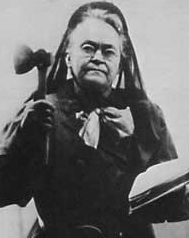
The vast majority of us who are nonsmokers or light drinkers should therefore think twice before endorsing the proposed tax hikes. The fact that we won't be much affected this time around should be of little comfort if it turns out that we are now in the grip of a latter-day Carry Nation who has more plans for subordinating our individual selves to the greater good.The 'Carry Nation' phrase compares Hillary Clinton with the hatchet-wielding Bible-bashing prohibitionist in the early 1900s who smashed up liquor stores.
After all, there is no reason to limit the politics of self-denial to just alcohol or cigarettes. A "sin-tax" proposal would raise taxes on just a few of many items whose consumption someone might wish to discourage and that are believed to represent, incidentally, a lucrative revenue source.
[The article tells the reader that David G Tuerck is executive director of the Beacon Hill Institute at Suffolk University and chairman and professor of economics at Suffolk.
It doesn't tell them that this article was bought and paid for by the tobacco industry for political propaganda purposes. Nor that part of his contract was to lobby his Congressman on the industry's behalf.]
1993 Aug 31: A Tuerck op-ed clipping is sent to some Tobacco Industry executive lobbyists (and copied to others) by Susan Stuntz:
Attached is another op-ed from the consulting economists. This one, by David Tuerck, appeared recently in the Brockton (Mass.) Enterprise
It is a pre-emptive strike, and is headed "Sin taxes and the politics of meaning: No way to pay the doctor." It attacks President Cinton and "Saint Hillary."
Congress should consider the Massachusetts example as well as the dubiousness of the Clintons' new theology before it rushes ahead to raise "sin taxes," should such a proposal be made. It appears that "politics of meaning" is nothing more than what the first lady means by politics.
1994 May 10: Tuerck followed up his "Carry Nation/Sin Tax article attacking Hillary Clinton with an article planted on the Boston Globe "Bad social science from Clinton"
The proposed tax on cigarette was a 75 cent reality, an it was intended to raise $10.4 billion annually to pay for the health care plan. His attack, this time, was on the advertising ("Joe Camel") which appeals mainly to children and teenagers — claiming:
To chalk it off to Joe Camel is to ignore evidence that consumer demand causes advertising, not the other way around.
[Just as eating causes hunger!]
To chalk it off to ignorance or susceptability to peer pressure or any other human characteristic is to ignore the fact that smokers consist of a cross-section of people embodying every imaginable characteristic.
[All subject to a daily bombardment of cigarette advertising costing the companies billions of dollars each year... apparently for no appreciable purpose.]
[He doesn't use the non-smoking claim, but again fails to tell the readers that this is paid industry propaganda.
At the same time Tuerck's old think-tank the AEI also publishes some material promoting the fact that advertising is consumed rationally and sceptically — an idea rejected by advertising agencies fifty years before. Coincidence? ]
1995 /E: The annual Media Relations Report at the Tobacco Institute lists all of the then-current list of academics writing op-ed pieces (including David Tuerck), together with newcomers.
He is still on their list as a current network participant.
- Dr Terry Ridgeway, University of Nevada, Las Vegas
- Dr Lowell Gallaway, Ohio University
- Robert Higgs, Independent Institute, Edmonds, Washington
- Dr Robert Pulsinelli, Western Kentucky University
1995 Dec 21: Savarese & Associate's Status report to Carol Hyrcaj at the Tobacco Institute on the FDA op-editorial program.
As reflected in the status report, we have replaced Iowa, Wisconsin, and the Houston congressional district with three new states (California, Massachusetts and West Virginia). As you know, we have already received Robert Sexton's (California) article, as well as confirmation that the economist in Massachusetts is able to participate.[That was Tuerck]
At this time, we are asking those economists that have published, to forward a copy of their article to their congressman/congresswoman.
1996 Jan 5: Status Report on FDA Op-ed Program. It lists 20 successful newpaper plants of their anti-FDA propaganda and the 20 economists who wrote these articles on commission:
MASSACHUSETTSAttached in front of this document is a model letter to be used by the professors when sending a copy of their article to a local Congressman.
David Tuerck, Beacon Hill Institute
Suffolk University, 8 Ashburton Place, Boston MA
Will have op-ed to us by the end of January.
[Of course the Congressman's cover letter makes no mention of the fact that the Tobacco Institute paid $3,000 to have the op-ed written.]
See also the earlier version of this report which details those op-eds which have been sent for revision again, before being submitted to their newspapers. One copy of this Report says that David Tuerck "Will have op-ed to us by the end of January."
1996 Feb 2: Savarese received the draft copy of Tuerck's FDA Op-ed. He was one of the last: most of the other cash-for-comments economists had already planted their articles and contacted their Senators and Representatives.
1996 March 1: Jim Savarese's staffer writes to the Tobacco Institute about the FDA Op-ed Program
enclosing a copy of Allen Parkman's published op-ed. They are now cracking the whip.
Based on our discussion, I sent John David (WV) a detailed memo addressing the problems with his article. The revised article we received failed to correct many of the original problems. As a result, we have dismissed him from the program. We feel that he may have a problem with tobacco issues, but did not want to come out and tell us.After Sub-editing and legal clearance, Jim Savarese had returned Dave Tuerck's new FDA-attack article to him on 13 February and Tuerck had, in turn, submitted it to the Boston Globe as all his own work.
At this time, I am continuing to ask the economists who have not published to contact their editors regarding the status of their articles. I am also urging those economists who have published, to contact their Congressman/Congresswoman if they haven't already done so.
[There was no further information about submission or contacting Congressmen]
1996 Mar 8: Kelleigh Varnum, of Savarese & Associations advises Carol Hrycaj at the Tobacco Institute that:
We have located an economist to replace John David (WV). His name is Cliff Dobitz (ND). The status report reflects this addition.John David [West Virginia Tech] had been fired for producing unsatisfactory op-eds, and replaced by Doblitz who was an old network contributor from North Dakota. Presumably, until then, he had not then been contracted to attack the Federal Drug Administration (FDA) which was the then-current project for both op-ed writing and contacting Congressmen.
Also attached is Ed Price's (OK) letter to Congressman Largent.
The Status Report for this FDA Op-ed Program records:
MASSACHUSETTS
David Tuerck, Beacon Hill Institute, Suffolk University
Boston Globe — returned article to economist 2/13
[This probably means Savarese returned the draft article to Tuerck on this day]
1996 Apr 6: Tuerck's article "Feds vs smoking: Enough already" This is an attack on the FDA's anti-advertising drive. He trots out the standard package of tobacco industry slogans.
Again he attacks the idea that advertising of cigarettes plays an important role in recruiting new smokers:
No government agency has less sympathy for this idea [individual sovereignty] than the Food and Drug Administration, and no government initiative does more to undermine this sovereignty than current efforts by the FDA to promote new and burdensome, regulations aimed at curbing cigarette sales.
By making cigarette ads dull, the FDA will likely diminish inter-brand rivalry without discouraging smoking. Putting Joe Camel out to pasture may simply encourage people to smoke other, less recognizable (and probably cheaper) brands.
Indeed, making ads dull will diminish the incentive of manufacturers to promote safer brands and of consumers to learn from advertising about the availability of safer brands.
[He offers no evidence here. He simply hypothesizes that safer, more expensive, well advertised brands could eventually exist!... and that children would buy them rationally by learning about them from advertising.
It's pretty difficult to imagine a more ridiculous piece of academic nonsense.]
1996 Apr 8: Kelleigh at James Savarese & Associates writes to the Tobacco Institute.
Carol:
Please find enclosed David Tuerck's (MA) published op-editorial. I will forward the original to you as soon as I receive it.
Also enclosed is Congressman Weldon's response to Dom Armentano (CT).
1996 Apr 16: Kelleigh Varnum updates his advice to the Tobacco Institute on the progress of the FDA Op-ed Program.
To date, 14 of 20 articles have published.The general list also records David Tuerck's other attempts.
- David Kurth (LA) informed us that his op-ed published on February 21, in Lagniappeu.
Apparently, there was a breakdown in communication with the editor and he did not realize that the article had published. Enclosed is a copy of the article. Unfortunately, it is of very poor quality. We will forward the original to you when we receive it.- Although the Atlanta Constitution has promised for quite some time to publish Dwight Lee's op-editorial, there still have not been any developments. As a result, we have directed Dwight to pursue other outlets for submission.
- Cecil Bohanon (IN) is contacting the editor of the Journal Gazette. He will pursue other outlets for submission if they decide not to publish his article.
- Publication of Barry Poulson's (CO) and Cliff Dobitz's (ND) op-editorials is forthcoming.
- Both Mike Davis (TX) and Terry Ridgway (NV) are checking with their editors on the status of their articles.
- Boston Globe - declined
- Boston Herald - Published April 6,1996
1996 June 24: Status Report on FDA Op-Ed Program lists the various network economists and the articles they have planted with their newspapers, together with the Congressmen who have been contacted. About this Massachusetts network economist it says:
MASSACHUSETTS
David Tuerck, Beacon Hill Institute, Suffolk University
Boston Globe — declined
Boston Herald — Published April 6 1996
Clearly the Boston Globe could smell the money behind the article, and they appear not to have published any of his subsequent articles. However the Boston Herald was not so astute, and they became a regular outlet for his op-eds.
1996 Dec 12: He made a speech condemning the cost of federal welfare at a Beacon Hill Institute conference: "Compassional Welfare Reform: Empowering Charities and Private Citizens."
What we have to begin with is what Robert Rector has correctly documented as a $5.4 trillion failure of a welfare program that, according to the Green Book, published by Congress, cost about $345 billion in 1994, and about 71 percent of which was picked up by the federal government.[Apparently this is what Tuerck believes is "compassionate welfare".]
Now, we've had a monumental Welfare Reform Act this year that doesn't do the job, although as an economist I think that it represents a step in the right direction, merely a modest one, unfortunately. The broad outlines of this already are clear to all of us here.
We know that it ends the existing entitlements in favor of a system of block grants; that it requires approximately half of all single mothers to be working by 2002; that there's a five-year limitation on benefits; bonus payments to reduce illegitimacy; and so forth.
1997 Aug 14: David Tuerck is promoting the services of his Beacon Hill Institute to lobbyists and legislators at the annual conference of the American Legislative Exchange Council (ALEC) in New Orleans — which is a bit like touting fencing services at a thieves picnic. ALEC was started by the Paul Weyrich and the Heritage Institute with funding from Edison Electric Institute and the oil companies as a way for corporations to influence legislators by bribery, junkets and campaign support.
At ALEC, Tuerck is with an associate, Howard R Wright, and they are recruiting for the Beacon Hill Institute in Boston which he says
"applies the free-market economic model to the solution of societal problems. Research topics include dynamic state tax modeling, welfare privatization and tort reform."He is also involved in an ALEC economic task force with William Shughart, Barry Poulson (both cash-for-comments network economists) and the notorious Grover Norquist.
[This is straight-out touting for lobbying business.]
1998 Aug 15: The Florida Press Journal carried an article "Government assaults success" by cash-for-comments economist Dominick T Armentano which attacks the McCain tobacco bill and the FDA.
The list of activities of other economists shows that the network continued to be operated by the Tobacco Institute itself (under Walter Woodson, and Lance Morgan - both Public Affairs division). Savarese is still in the picture, but the op-eds are now being rejected by many newspapers, who are no longer willing to publish tobacco industry propaganda.
And, since legally discovered tobacco documents had already begun to appear on-line, the Tobacco Institute has carefully deleted the names of the Professor of Economics who wrote each op-ed piece.
Tuerck is listed under the heading
MASSACHUSETTS, Suffolk UniversityClearly his having difficulty in placing his op-eds.
- DECLINED: Boston Globe
- DECLINED: New York-Times
- DECLINED: Boston Herald
1999 June 24: The revised version of quotes and talking points from the part tobacco-funded book "Advertising and Constitutional Protections Around the World" It says:
The information contained in this book was collected under the auspices of The International Advertising Association (IAA) - which was formed in 1938 and is the only worldwide tripartite association in the marketing communications field. It also reflects the contributions of Hall Dickler Kent Friedman & Wood, which gathered and analyzed the study data.
IAA's Richard Corner has observed that advertising is, in fact, crucial to the economic survival of media, keeping its price to consumers reasonable and affordable. "It provides, he said, "some 85 percent of newspaper revenues, 65 percent of magazine revenues and 100 percent of privately owned commercial radio and television stations."
[Corner was in fact a top Philip Morris Europe executive seconded to the IAA to fight against cigarette advertising bans]
David Tuerck, of the Beacon Hill Institute for Public Policy Research, and Professor and Chairman, Department of Economics, Suffolk University, Boston, Massachusetts, presented a vivid picture of what the world might be like if advertising's critics prevailed and it was legislated out of existence (Tuerck, D., Interpublic Group of Companies' 1987 Annual Report).
In a world without advertising, he wrote, in part," consumers would lack a means of distinguishing one product from another. Producers [of products and services] lack a means by which to reward themselves for successfully establishing a particular product as a benchmark for quality. They find that they profit most by attracting the least attention and that the smart tactic is to cut costs and avoid being noticed for any loss in quality that takes place as a result.
Further, Professor Tuerck observes,
A world without advertising thus turns upside down the idea of offering a product that permits the seller to stand out from the crowd. "
"By eliminating an important means by which to compete, the disappearance of advertising would discourage competition. It would encourage producers to behave as they did in the world of the medieval guilds or of old-fashioned Soviet-style factories...
In that world, active selling or promotion by producers is taboo. Producers shun the uncertainties of competition, where failure to attract the consumer's patronage is as likely as success, for a quieter life wherein 'cooperation' replaces competition.
"Just as it would discourage producers from competing over quality, the disappearance of advertising would discourage them from competing over price. Producers would lack an adequate means to inform consumers that they had cut prices. Consumers, having to rely on more costly and time-consuming methods of making price and quality comparisons, would go on paying higher prices even when lower prices were available. ""Without advertising we would return to the earlier world - a world of high retail price margins, scarcer goods and the disappearance of the advertised brands to which generics and private labels owe their justification and acceptability.
A world without advertising would lack the volume and diversity of print and electronic media that we know and that we take for granted. Many publications and programs would disappear. The survivors would suffer enormous increases in price. Government would find itself filling yet another governmentally-induced vacuum in the marketplace, with all the predictable consequences for free speech and market innovation. "
Any reduction in factory price made possible by the elimination of advertising would be offset by other promotion costs that manufacturers would incur in selling to retailers and wholesalers, by the increased market power that merchants would acquire over consumers, and by the increased difficulty that consumers would have making price comparisons among merchants.
"Because manufacturers could not appeal directly to consumers without advertising, they would lose an important incentive to improve existing products and to introduce new ones. The consequences would be especially severe for the very products that supposedly benefit the consumer the most.... "
"This, then," he concludes,"is the world without advertising. In this world, the image of manufacturer and merchant vying rigorously for the consumer's patronage is replaced by another image. It is the image of the consumer reading his government-edited newspaper as he waits in line to buy goods he doesn't recognize, at prices he can't compare, for the purpose of satisfying want that could be better satisfied by goods about which he will never know."
[The sky would fall.
He goes on to attack government funded media like Public Broadcasting Service, the British Broadcasting Corp., Australian Broadcasting Corporation, etc as being like "Czarist Russia".
The InterPublic Group he was writing for in 1987 was on its way to becoming one of the three super-media-conglomerates which hold most of the advertising, public relations, lobbying, polling and campaign managment companies around the world. This one secretive media corporation probably has more media clout than the combined governments of Europe.]
2001 Sept 6: "Universal health care plan proposed"
The first phase of the proposal drafted for the Maryland Citizens' Health Initiative would cost about $1 billion, but would require only one tax increase, a 70-cent tax hike on each package of cigarettes, Vincent DeMarco, the coalition's executive director, said Thursday.
Most of the remaining cost would be covered by federal funds, premiums paid by workers and employers and money the state already spends on health care for the uninsured, DeMarco said.
But a study released on Thursday by a rival organization, the Maryland Foundation for Research and Economic Education, said any attempt to provide universal health coverage would require huge tax increases and would result in the loss of as many as 117,000 jobs in Maryland.
A study conducted by the Beacon Hill Institute at Suffolk University in Boston looked at four options. It estimated that costs would range from $1 billion for an expansion of Medicaid to almost $12 billion for a program funded entirely by the state.
David Tuerck, project director for the study, had not seen the coalition's plan Thursday, but he said he believes it would require substantial tax increases, huge levies on private business or a combination of the two.
"Money that goes into this has got to come out of something else. Taxes have to be raised ultimately," he said.
The inevitable result would be a substantial loss of jobs as workers moved to other states with lower taxes and business expanded or moved out of Maryland to avoid high costs associated with the program, Tuerck said.
The study was conducted for the Maryland Foundation for Research and Economic Education (FREE), a group set up to give Maryland businesses a greater role in setting public policy
See Heritage Institute study by Tuerck and Beacon Hill Institute,
2004 Sep: "The Impact of Drug Reimportation and Price Controls: The U.S. and Massachusetts," David G. Tuerck et al. for the Institute for Policy Innovation Policy Report.
This think-tank was founded and run by Dick Armey, and funded by the Koch Brothers and by ExxonMobile, Claude R. Lambe Foundation, Scaife Foundations, the Bradley Foundation
2005 Nov 30: Doug Bandow (a well-paid tobacco industry consultant, as well as a newspaper columnist) is writing for CATO's Policy Analysis on "Avoiding Medicare's Pharmaceutical Trap" — in opposition to the federal drug benefit program.
He quotes Tuerck as providing evidence that:
... the cost of drug development has been rising sharply. The cost of bringing one new drug to market in the 1980s was $100 million. Largely as a result of Food and Drug Administration regulations, that cost rose to more than $800 million by 2003.
[And saved millions of lives around the world by insisting on thorough testing before release.]
2008 Jan 17: DeSmogBlog records: "Phony 'Peer Review' tries to Undermine Climate Action in North Carolina." by Mitchell Anderson. Jan 17, 2008.
DeSmogBlog
2008 Mar:
Speaker at the Heartland Institute's 2008 International Conference on Climate Change.
2008 Apr 22: "The Economics of Climate Change in North Carolina" (PDF) has been presented to the Legislative Commission on Global Climate Change. His conclusions:
"Proposed legislation may provide benefits but they have yet to be determined."
"The legislation would impose measurable costs on business and on the economy" so the commission should "weigh these costs against the purported (and so far unsubstantiated) benefits."
2009 Apr 15:
Tuerck spoke at the "Boston Tea Party," an event organized by the Tea Party to "voice their displeasure with the egregious growth of government and the irresponsible policies our local, state and federal governments are pursuing."
Included in these irresponsible policies is anti-global warming policy, which Tuerck says will "stifle economic growth, kill good jobs, and drive up energy costs."
Exxonsecrets.org web site says that he was a guest speaker at a Tea Party rally on Boston Common. He is also involved with the Heartland Institute in climate denial. See sources at:
2009 Jun:
Speaker at the Heartland Institute's 2009 International Conference on Climate Change.
2010 Feb 8: The Boston Herald is still regularly taking op-eds from David Tuerck. These don't appear to be tobacco-related, so some other organisation must be paying him to write them.
2011: There appears to be a tax-deductable "David G Tuerck Foundation for the Study of Economics & Humanitie" [sic] based in Boston Massachusets.
[Another version has "Law" inserted and the slogan "Scholarship in Service of Freedom"]
2011 Jun: Along with "all the usual suspects", Tuerck is a recognised climate-denial speaker at the Heartland Institute's Sixth International Conference on Climate Change.
They even have S Fred Singer on their list still.
CONTRIBUTORS:lrt3 TRMU jrtm


This work is licensed under a Creative Commons Attribution 2.0 Generic License